Buying a car for a company in China
This article focuses exclusively on purchasing a car—of course, a new car—for a legal entity in China. It is totally different from the cases when a car is bought by an individual or when a used car is acquired.
The first thing to consider is the city where your company is registered. If this is one of the fifteen cities of the first line, which implement the car-restriction policy, then the procedure in any of them will be more or less similar, somewhere it can be a little stricter (Shanghai), whereas elsewhere (Guangzhou) more lenient. In this example, we consider the purchase of a car in Shenzhen. In case of acquiring a car somewhere else, this guide might be far less reliable.
First, buying a car for a legal entity will only be possible from a dealer in the city where your company is registered. Otherwise, you simply will not get a license plate. Having found a dealer and discussed the car equipment with the manager, you pay a deposit by a regular bank transfer (usually 10% of the cost of the car). When the car has arrived after a waiting period (from a couple of days for a typical running package to nine months for a—let’s say—red convertible), you need to pay the principal amount. At this point, the purchase formalities are completed. You get 增值税发票(VAT-fapiao) from the dealer and that’s it.
It is also noteworthy that buying a car by a legal entity is not an expense (成本), but an asset (资产). Thus, the purchase of a car does not reduce the tax base.
It is advisable to take care of obtaining a car number long before buying a car. In Shenzhen, everything happens on the platform 小汽车增量调控平台, which is a platform for regulating the increase in the number of light cars.

A small digression might be required at this point. In total, a car number in the aforementioned first-line cities can be secured in three ways:
- auction of premium numbers. Held once a quarter, beautiful numbers like 粤V88888 are put up for sale, the price can reach up to two million yuan. Buyers of such numbers are completely exempt from the restrictive policy towards non-local numbers, regardless of where the number was purchased. But that’s another story
- lottery. Held once a month, free of charge, the chance of getting a local ordinary number is 5%
- auction of ordinary numbers. This is what I will delve in now. Please take another look at the screenshot above.
On a monthly basis, towards the end of the month, all those registered on the above platform receive a notification about the date of the auction and the minimum effective price at the last auction + quota for auction numbers in this month. In Shenzhen in 2022, it decreased from 72,000 yuan in July to 29,000 in November.
This price reflects the number of applications. Let’s look at an example. First of all, a quota for auction numbers is allocated for a specific month, e.g. for December. Imagine 2000 were allocated. You can offer any price at the auction, starting from 1 yuan. Accordingly, at the end of the auction, the first 2000 participants in the list, ranked by the price they offered, will receive numbers. Accordingly, the fewer participants, the lower the entry price and vice versa.
In December 2022, the November pass price of 29,000 yuan was known. On the day of the auction, which opens at 09:00, you can make three bids. From 09:00 to 11:00, from 11:00 to 13:00 and from 13:00 to 15:00. After each period, the average price of the previous bid is shown – the screenshot shows that at 09:01 we declared 36,000 yuan, and at 11:00 we saw an average price of 31,615 yuan. The rate can be adjusted twice, and after two iterations, after 15:00, the pass price of this month is shown. The third time we declared 41600, and the pass price turned out to be 41,100, so it turned out to be a success.
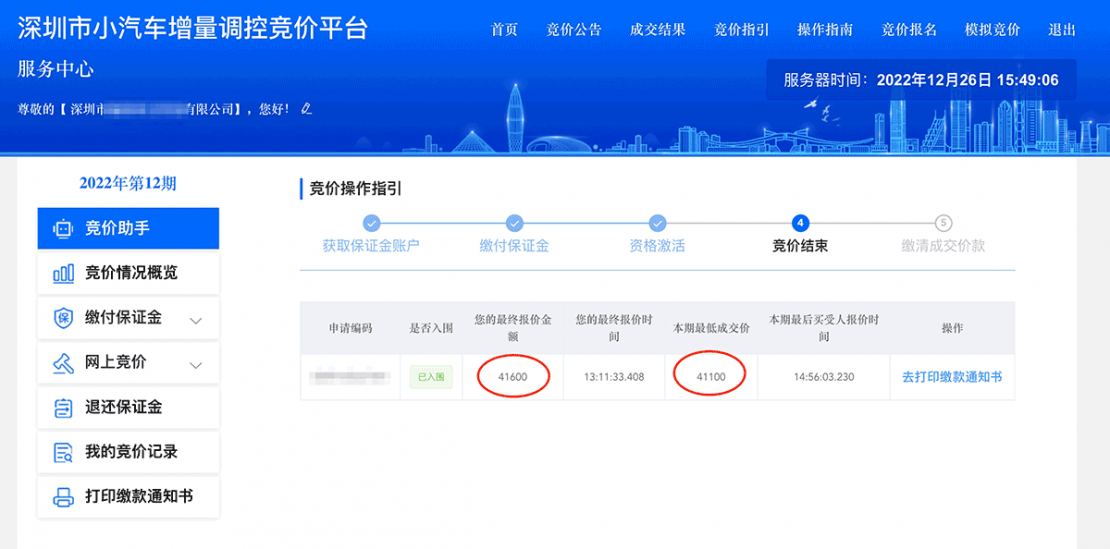
After that, you need to pay the declared amount to the account of the local traffic police, for which you will be issued a notification (通知书)

With which you need to return to the car dealer’s office, where they will log into the vehicle registration service under their account, and you will be able to select a number. You have 120 seconds to choose a number.
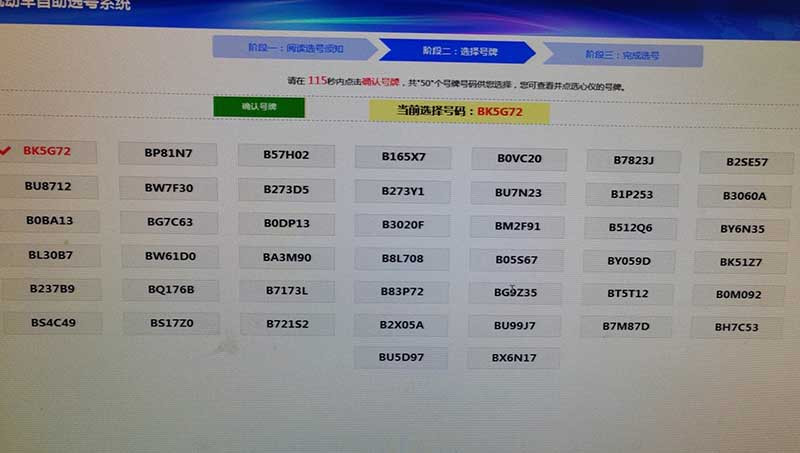
Naturally, based on the format of Chinese car numbers, it will be possible to select only numbers and letters after the character of the province and the letter of the city. The Chinese license plate always consists of the character of the province (or city of central subordination), in our case – 粤 (Guangdong) and the letter of the city (A – Guangzhou, B – Shenzhen, C – Zhuhai, and so on), that is, in our case, the part with 粤B was fixed. Also, the number never contains the letters I and O, in order to avoid confusion with 1 and 0.
Five minutes after choosing a number, you can pick up its paper copy on a special form, which is placed under the wind screen and is valid for one month. Permanent numbers will be sent by mail within a week. Permanent numbers have designated colours: blue for ordinary cars, green – electric vehicles and hybrids, yellow – municipal transport and transport of carrier companies, most often trucks, yellow-green – municipal and carrier transport with an electric engine. There are also whites (police), blacks (diplomatic and cross-border), green (civil aviation, intra-factory), etc., but this is not the matter at hand.
After that, it is possible to register on the traffic police portal, create accounts in parking services, purchase fuel cards and ETC, and so on. In terms of the car as a property of the company, it might be useful to bear in mind the following:
- To compensate for parking costs, you will have to either collect paper fapiao manually, which you then submit in the advance report, or register with services that allow you to replenish your parking account by transfer from a company account. Unfortunately, at the moment there is no all-China service of this kind, most often it will only function at the level of a province, or even a given city.
- It is also possible to purchase and replenish a fuel card for a certain network of gas stations at the expense of the company. Or, as mentioned above, collect paper fapiao and submit an advance report.

3. ETC is more complicated, since there is not yet a single operator that collects tolls on highways, which means that there is no entity to which money could be transferred from the account of the car-owning company. As a result, advance reports are the only option as far as ETC is concerned.