Documents for citizens and residents in China
Big China is understood to comprise four regions – the PRC itself, two SAR (special administrative region) – Hong Kong and Macau, as well as Taiwan, which is not a country de jure.
So, in terms of the status of an individual within the state, the situation is simplest in the PRC. A citizen of the PRC (中华人民共和国公民) is simultaneously and invariably a resident of the PRC (中华人民共和国居民). One of their fundamental attributes is its mainland (大陆) 户口 (hukou – something like residence registration and registration, but much deeper and more extensive. For example, a holder of the Beijing hukou, even having sold an apartment in Beijing and having lived abroad for ten years, will still remain its holder, while a buyer of an apartment in Beijing, in addition to the purchase itself, must meet a lot of criteria to obtain a hukou).
So, in the context of the topic under consideration, there are three main attributes of a hypothetical Wang Liwei:
- citizenship – 国籍 – PRC
- residency – 居民身份 – PRC
- hukou – 户口 – PRC
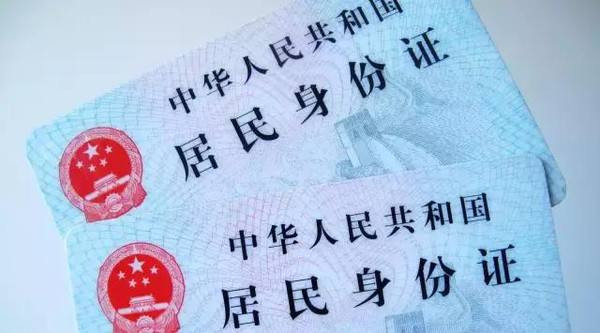
Accordingly, his main identity document will be the “The PRC citizen identity card” – 中华人民共和国居民身份证
To travel abroad (with some exceptions, which will be discussed below), he uses a passport of a citizen of the PRC – 中华人民共和国护照

Now about SAR. In 1997, Hong Kong changed its status, turning from a British Overseas Territory into a part of the PRC under special conditions, which should remain in force until 2047. In particular, there is a border between Hong Kong and the PRC, they have different currencies, varying visa policies, and so on. But at the same time, the Citizenship Law is the same for both the PRC and its SAR, Hong Kong does not have its own army, etc. That is, it is an autonomy within a single state, but at the same time it is a separate state. In the PRC proper it is called 一国两制 – “One country - two systems”.
Well, this topic is extremely extensive, within the framework of the article we will dwell only on documents and statuses.
Hong Kong citizenship does not exist. As noted above, citizenship is the PRC. All people living in Hong Kong in 1997 automatically became citizens of the PRC (if they did not reject it) and permanent residents of the SAR. And this is where lies the main difference between China and Hong Kong – in the status of a resident (居民).
That is, correcting our previous list in accordance with the status of Zhou Tai Fu, a resident of Hong Kong, he has the following attributes:
- citizenship – 国籍 – PRC
- residency – 居民身份 – Hong Kong
- he has no hukou. Within the framework of the policy “One country, two systems”, the authorities combined the two terms “hukou” (户口) – residential registration and 国籍 (citizenship) and coined 户籍 – something between citizenship and residential registration. His 户籍 is Hong Kong
Accordingly, his main identity document will be 香港永久居民身份证 - Hong Kong Permanent Identity Card.

To travel abroad, he uses the passport 中华人民共和国香港特别行政区护照 – the passport of a citizen of the PRC Hong Kong Special Administrative Region.

And this is where the fun begins. Although he is a citizen of the PRC, due to “One country, two systems”, he cannot use his passport to travel to the PRC, since a passport is a document for travelling abroad, and he doesn’t leave the borders of his country – the PRC. Therefore, to travel to the PRC, any resident of the SAR must obtain a 港澳居民往来内地通行证 – a pass to the mainland for residents of Hong Kong and Macau.

The same is true for the citizens of the PRC mainland. To travel to Hong Kong, they need 往来港澳通行证 – a pass to Hong Kong and Macau.

In reality, this means that a citizen of the PRC flying on the Moscow-Hong Kong route with a transfer in Beijing and taking only their passport with them will smoothly board a plane in Moscow, but in Beijing s/he will not be allowed to board.
If a citizen of the PRC, being a resident of Hong Kong, flies along the same route, then s/he will board a plane in Moscow, but s/he will not get out in Beijing, since their passport of a PRC citizen is not valid for crossing the PRC border. Holy Christ!
You can write novels about the change of residency, hukou and 户籍. In theory, this is very simple – in order to obtain the status of a permanent resident of the SAR, you need to meet only two criteria:
- be a citizen of the PRC
- legally get 户籍 in SAR
In practice, this is a little more complicated.
This means that a citizen of Russia Petrov, having arrived in Hong Kong and having lived there for seven years, has the right to obtain the status of a permanent resident of the SAR of the PRC. But no citizenship. For travel to the mainland, he will receive a visa according to the standard procedure and use his passport for travel. This is approximately what the scheme of statuses “foreign citizens” – “regions of the PRC” looks like.
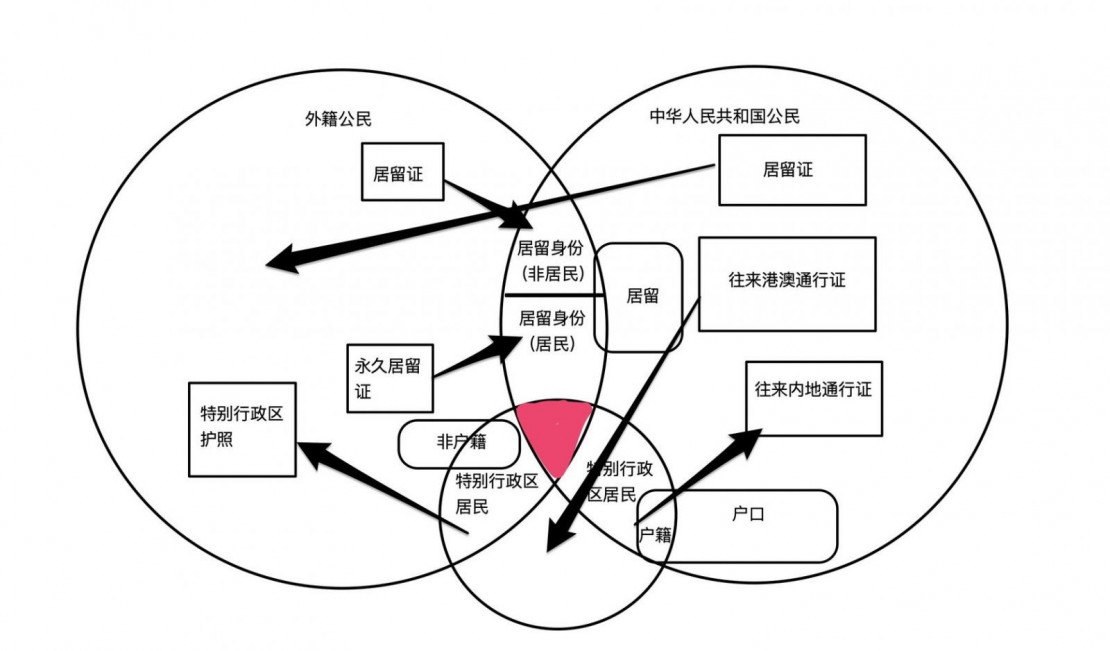
If Taiwan is added to this equation, the complexity of the scheme will increase by an order of magnitude. Taiwan is not recognized by the PRC as a sovereign state and the passports of both the PRC and Taiwan are not valid for travel to one another. For this, the MPS of the PRC issues 大陆居民往来台湾通行证 – a pass of a resident of the mainland for travel to Taiwan.
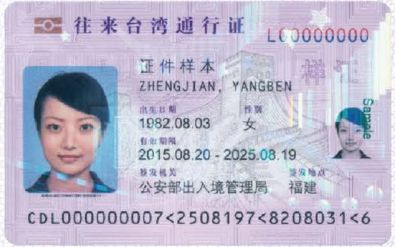
And visa versa, residents of Taiwan require 台湾居民往来大陆通行证 – a permit for a resident of Taiwan to visit the mainland.

Everything seems to be complicated, but comprehensible. But, let’s say, what to do if Petrov, who is a resident of Hong Kong, wants to go to Taiwan. As we remember, on no occasion will he receive the passport of the SAR of the PRC. Then he needs to get 香港特别行政区签证身份书 – Document of identity for visa purposes.

This is, in fact, a drop in the bucket. We have not touched upon the issues of diplomatic and service passports. We have not approached the topic of documents of stateless persons, owners of Laissez-Passer, Titre de voyage and the like. Holders of two citizenships and dual citizenships. Passports of partially recognized and unrecognized states. Documents of minor children. Finally, I’d like to ask you – do you know how many types of travel documents are there in Timatic? Parenthetically, Timatic is a unified system for airlines that determines who can fly where according to what documents. The lady at the registration desk looks into it, registering you and sees on Timatic – a citizen of Russia, travelling from China to Australia – a visa is required. And asks to show it.
You know what? There are 56 types of documents.