Settlement and cash services in China
Despite the fact that offline payments are being increasingly crowded out by online ones in China year on year, direct purchases at the checkout cannot be fully neglected yet. In this article, we will consider ways to accept direct payments from customers at the offline checkout.
First of all, it is, of course, cash. There is next to nothing to tell here, as the intricacies of accepting cash belong to the areas of accounting and reporting, rather than IT. In addition, as for 2021, it may be hard to find a seller eager to accept cash. By law, of course, they are obliged to do so, but it may be highly unlikely that a convenience store will be able to accumulate enough change for a 100 yuan banknote in a day. Some organizations (for example, government agencies) are prohibited from accepting cash at all. Thus, there are three types of payment “at the checkout” in China nowadays:
- third-party payment systems – directly or through an acquirer
- bank cards
- digital yuan, aka E-CNY, aka 数字人民币
Now here is a bit of theory. Each transaction involves at least 3 participants:
- payer
- acquirer
- payee
While everything is clear with the payer and the payee – the first one is the very buyer who has money in any form, and the payee is most often the seller, who is a legal entity (or a sole proprietor, or an individual taxpayer) – the acquirer is a more tricky thing. This is the one who directly handles the transaction, that is, provides the technical means for its processing, which may differ case by case. There are various models for its participation, and it is this models of acquiring that I would like to elaborate on in this article.
Let’s start with third-party payment systems, which are the easiest case in point. As for 2021, Alipay and Wechat control 91% of the market in China, with 100% of the population having an application of at least one of them. Besides that, there are throngs of smaller ones (mobile wallets of all three mobile operators, JD and a dozen others, whose share is negligibly insignificant).
Now then, in the case of a third-party payment system, payments run directly through them and do not involve any other parties. Virtually everything happens within their framework (Wechat or Alipay). There is a unique payer number, a unique seller number and an acquirer (in this case, Alipay or Wechat itself). When paying, the payer enters the payee’s number (most often by scanning the payee’s QR code) and indicating the amount. The acquirer debits the corresponding amount from the payer’s account in a very simple way (since everything is within the same system) and credits it to the seller’s account.
The workings are a trifle different (but generally the same) if the payer uses a bank card/account linked to the Wechat/Alipay wallet, rather than the balance of the wallet itself. Then the acquirer first debits the amount from the linked card/account and only then transfers it to the payee. In the future, the payee can make use of this amount according to the circumstances (withdrawing it to the legal entity’s bank account, or making direct payments from the account opened with the acquirer).
From a practical point of view, the payee needs to print out their unique ID (most often as a QR code) and hang it in a conspicuous spot where it will be visible to the payer (收钱码). Or connect 当面付, in which you need to get a QR code scanner (a mobile phone is also suitable) and scan the QR code of the payer. All payment products are linked in the Wechat/Alipay admin panel, depending on the needs of the seller.
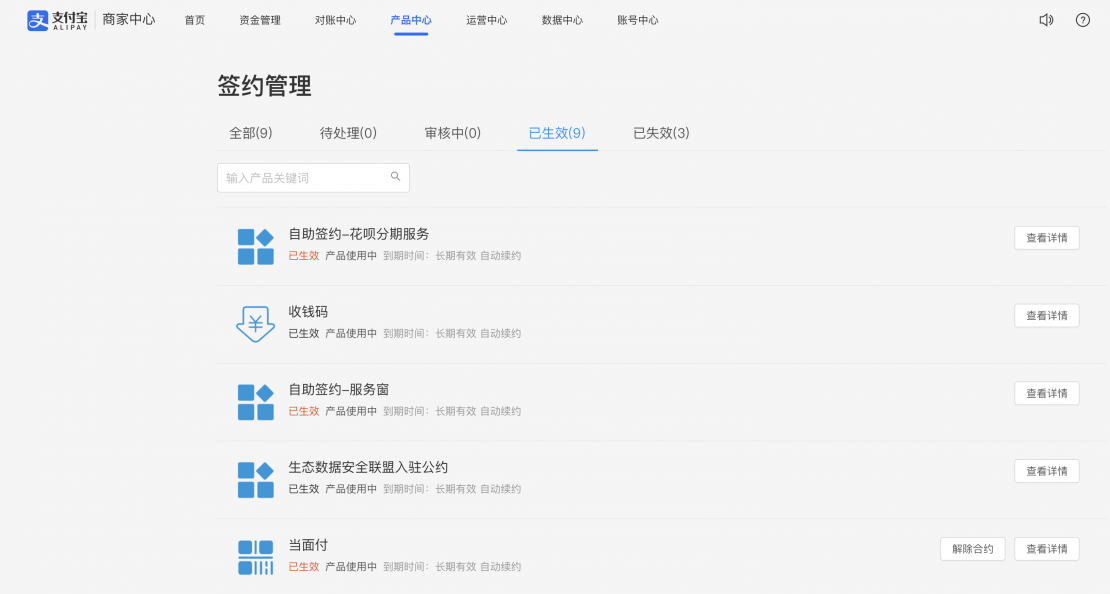
As you can see, in the list of connected products (签约), there are mandatory ones like security plugins, which cannot be disabled, as well as various methods of accepting payments
The tariffs of Alipay and Wechat are the same and range from 0.1% to 0.6% of the transaction amount (depending on the field of activity).
The advantages are obvious – ease of connection, no need for additional development and integration, no fees for third-party services. The disadvantages are also clear – for each system you need to keep a separate record of income/expenses, each system needs its own separate QR code, and the payment becomes impossible if the payer does not have Wechat/Alipay or is unwilling to pay with them (which is almost unbelievable, but sometimes it still happens). Therefore, there is another option for accepting payments from third-party payment systems with the help of an acquirer.
As in the case of accepting payments directly, and in the case of working through an acquirer, there is a wide variety of additional functions that can be connected directly in the settings. For example, in Alipay, as can be seen in the screenshot above (as well as when using other services), it is possible to connect installment payment service – 花呗. It is also possible to check the payer’s credit rating at the time of the purchase (in the case of Alipay it is called 芝麻信用) and, depending on the rating, provide other additional services.
Now let's talk about the acquirer. Acquirer, as already mentioned, is a company that directly contracts with many third-party payment systems and provides the client with an all-in-one solution. Accordingly, it is not required to sign agreements and carry out integration with each payment system separately – it is enough to conclude one contract with an acquirer, which will accumulate money from different payment systems and transfer them to the payee according to the designated account details.
There are a lot of acquirers in China, but the undisputed leaders are 美团收银台 and 拉卡拉. Surely, acquiring can be provided by any bank as well as by some third-party services, but these two are unrivalled in terms of prevalence and ease of use.
Their payment terminal is similar to the usual POS terminal, however, in addition to slots for bank cards (with magnetic tape and with a chip) and an NFC area for contactless cards, it also has a screen for displaying the seller’s QR code (which should be scanned by the buyer) and a camera for scanning the buyer’s QR code (depending on the payment method).

As can be seen, we have connected Wechat payments, Alipay payments and payments with UnionPay bank cards (including Apple Pay, Samsung Pay, Huawei Pay and others, which are also considered bank cards) to our 拉卡拉 terminal.
In the same way, everything is also extremely simple with bank cards – after concluding an agreement with the acquirer and setting up the terminal, you insert the client’s card into the terminal (or tap a contactless card), ask the client to enter a pin code (depending on the settings) and hand one copy of the receipt to the payer.
The standard commission for paying with debit and credit cards is 0.5% (but not more than 20 yuan), for paying with Apple Pay and others – 0.5%.
Things get a little more complicated if it is required to accept cards issued by banks outside of China. Then you cannot go by without direct acquiring services of the bank with drastically different commissions (2-3% of the transaction amount). But for most shops and establishments away from tourist routes, this functionality is almost useless.
Last but not least, the hero of the day, who inspired the writing this article, is digital yuan, aka E-CNY.
A detailed description can be found on Wikipedia or other resources. In short, it is a completely electronic currency issued by the Central Bank of China, which does not have a physical embodiment (coins and banknotes), supports blockchain verification and allows transactions between a pair of offline devices. It is currently in the process of test operation, is available to the general public, with mass implementation and transition to it expected in early 2022.
To accept digital yuan payments, it is required to:
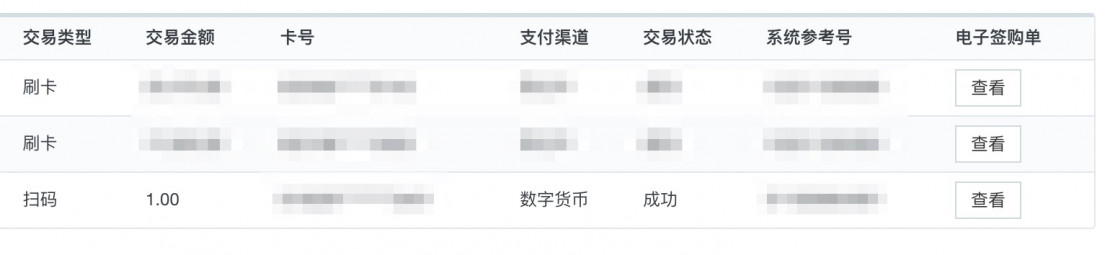
Enable the “digital wallet”(16 unique digits) feature in corporate online banking and connect any acquiring service (in our case it is 拉卡拉 again) for seeing every single transaction in the same interface. Or accept payments by QR code using a mobile phone and the “digital yuan” application (either as a separate application or as a function within client banking). Or ask payer to transfer the required amount directly to the "digital wallet" of your legal entity.
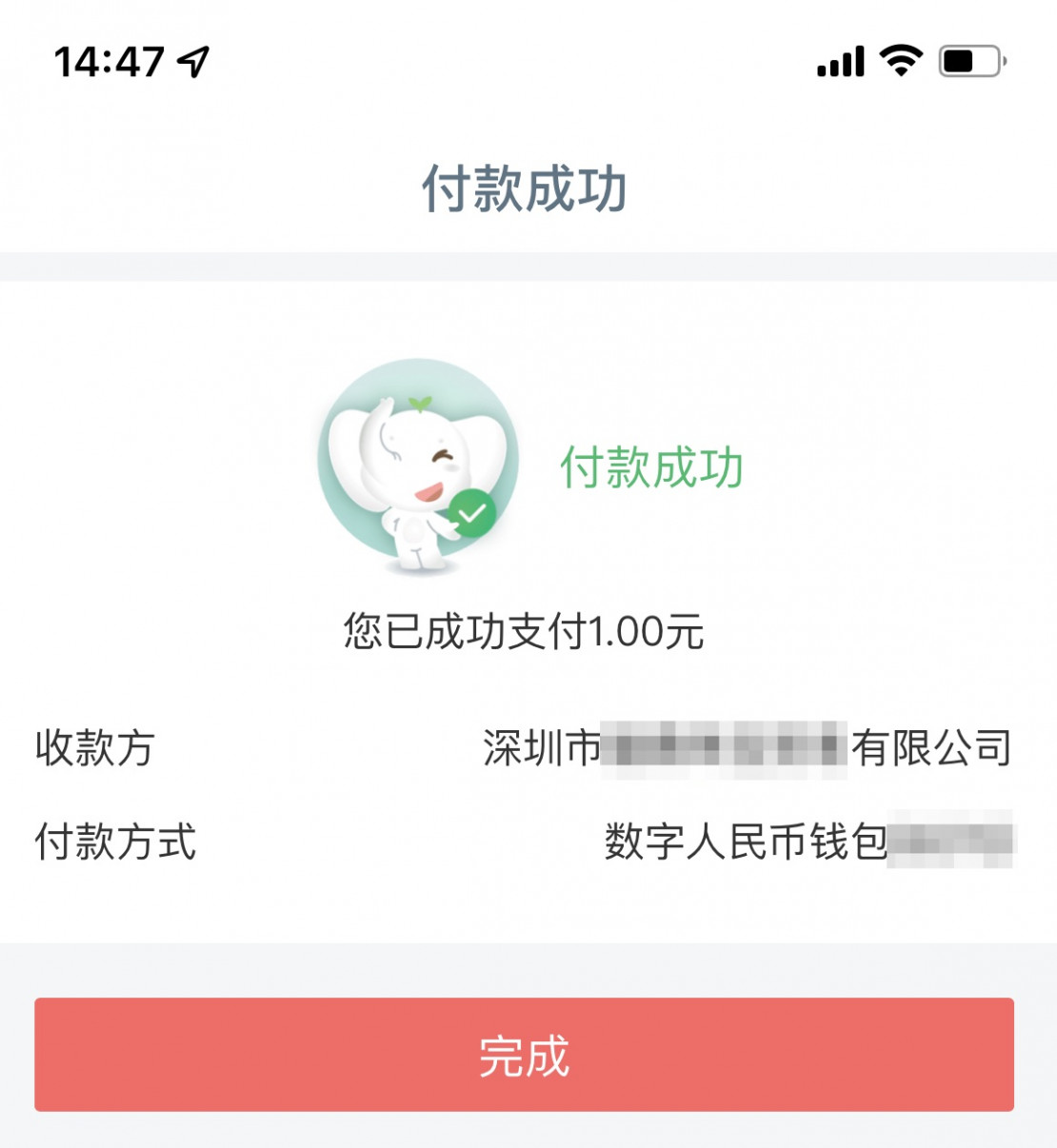
That is, on the part of the user, payment in digital yuan does not differ from payment by third-party payment systems in any way. There are no discrepancies as well on the part of the seller and with regard to the acceptance of payments.
The illustrations below show what payment in digital yuan looks like from the side of the payer (test payment of 1 yuan).
And from the side of the payee (in our case, it is the admin panel of 拉卡拉)
Currently, the transaction fee is 0%. Both for paying with it and for transferring money between the wallets of different people.