Social insurance system in the PRC
So, you are legally employed (otherwise, you will not be able to join the social insurance system) and it's time to think about how you will get medical treatment if something happens, receive a pension (why not), and so on.
Now then, the state social insurance system of the PRC -中华人民共和国社会保障
Actually, a foreigner can use three different types of insurance while in the PRC.
The first is international insurance. There are thousands of terms and conditions, as well as insurance companies, but the main point is that this insurance is international, with all that it implies. It may have limitations on the time spent abroad (for example, my international insurance from Alpha Insurance only works if the insured is outside Russia no more than 90 days a year). It has significant restrictions on the hospitals that cooperate with it – for example, while there is a 100% probability that a suitable hospital will be found in Beijing, when I was in Taichung (Taiwan), I was taken to Taipei, because there were no hospitals in Taichung that Alpha works with. Son on and so forth. Naturally, there are other international insurances, but most of them are more suitable for tourists than foreigners permanently residing abroad. And in terms of price – insurance for a reasonable amount, which covers staying abroad 365 days a year, with a minimum deductible, and so on – will cost you several times more than social insurance.
The second is commercial insurance 商务保险 within the PRC. It is also provided by a huge number of companies with a variety of plans and amounts, but the main difference is that this insurance works ONLY according to the 报销 principle. That is, you spend your money on treatment, and then, during a certain period of time, the insurance company will compensate you in full or in part.
Well, the third is the social insurance considered in the article, which is the only one that works immediately and BEFORE payment. But this applies only to healthcare, while the rest will be discussed below.
The recently completed reform of the social insurance system implies that all insurance for officially employed workers is paid according to a single system of 五险一金 (five types of insurance – one fund). You cannot pay them separately. So far, there are people who have obtained separate social health and pension insurance, but new ones are no longer offered. Today, the social insurance system in the PRC includes:
- pension insurance - 养老金
- health insurance - 医疗金
- accident insurance -工伤金
- job loss insurance - 失业金
- the maternity fund (oddly enough, men also pay contributions to it) 生育金

How much do I need to pay?
A detailed calculation of contributions can be found in the previous article, so here it is at a glance:
- pension insurance – 16% is paid by the company and 8% by the employee (pension rates are set by the city. And it may differ by region – in May 2019, for example, the share of the company was reduced from 19% to 16%, still in some places 19% remains. But as I said, we are considering everything on the example of Beijing)
- health insurance – 10% is paid by the company and 2%+3 yuan – by the employee
- accident insurance – 0.2% is paid by the company
- job loss insurance – 0.8% is paid by the company and 0.2% – by the employee
- the maternity fund – 0.8% is paid by the company
The part labeled "paid by the company" would not usually be seen by the employee. Only their part is directly deducted from their salary (as we remember, the contract specifies the salary "before taxes")
Payment of social insurance contributions is MANDATORY for all legally employed in the PRC. Particular benefits may be set for certain categories of workers, specific administrative-territorial units, for a certain period (as, for example, in Shanghai, participation in the system for foreign workers is voluntary until 2021), but unless otherwise stated explicitly, this is mandatory.
How to join?
Nothing is required from the employee – the whole process is carries out by the company. When a person gets employed, s/he and their salary are uploaded to the admin panel of the social insurance administration. Since then contributions are paid automatically, about which the company’s 经办 receives an SMS from 12333
In terms of details, the situation differs by region, but in Beijing, for example, immediately after registering in the social insurance system, an employee receives a temporary policy that can be used immediately, and within 3 months the card will arrive to them by a 实名-parcel. Whereas in Guangdong, for example, after registering with the social insurance system, an employee oneself goes to a bank branch, where this card is issued for them.
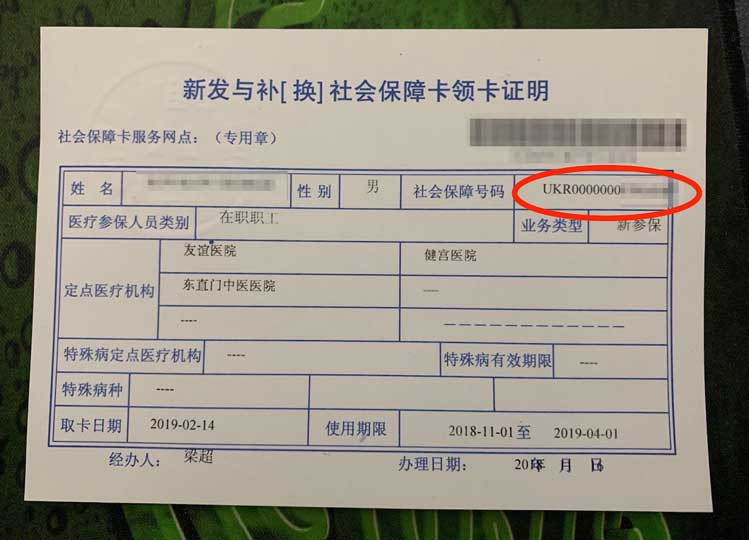
The social insurance number is UKR\RUS+zeros+your passport number circled in red [/caption]
It is very easy to use. With regard to healthcare services – just give the card to the nurse at the reception. With regard to pensions, it is still too early to speculate and not a single case of receiving a pension by a foreigner in China has been registered. But in theory, after 15 years of work (not necessarily continuously), you can apply for a pension and receive everything that has accumulated in the pension account in small portions. Depends on the age of retirement – see the corresponding article for more details. If you want to buy medicines, then you need to find a pharmacy with a sign 医保定点 – there you will be able to buy medicines using the money accumulated on the medical account.
As you can see on the temporary card, there are three hospitals, which I have chosen myself. These will be the hospitals in which the percentage of money compensation will be the highest. There are a huge number of intricacies, in fact, everything depends on:
- the hospital itself – in three to five selected ones it will be the cheapest, in the rest of the hospitals in the city it will be more expensive
- level of the hospital – all hospitals in China are divided into 一 、 二 、 三级 (1, 2, 3 level), and each level is divided into 甲 、 乙 、 丙等 (A, B, C). There are a bunch of criteria, for example, the medical staff of a first-level hospital should number 20 to 99 people, while that of the third-level – over 499 people. Naturally, the lower the level of the hospital, the less the employee spends and the more is compensated by the state.
- location – in the administrative-territorial unit where the card was issued and where the hospitals are located, it will be cheaper than in others
In general, the proportion of compensation (without taking the nuances into account) will look like this. Take, for example, an ordinary standard Beijing hospital of the third level. At 门诊 (medical visit), the cost of a doctor's appointment is 30 yuan, 28 of which are covered by insurance.
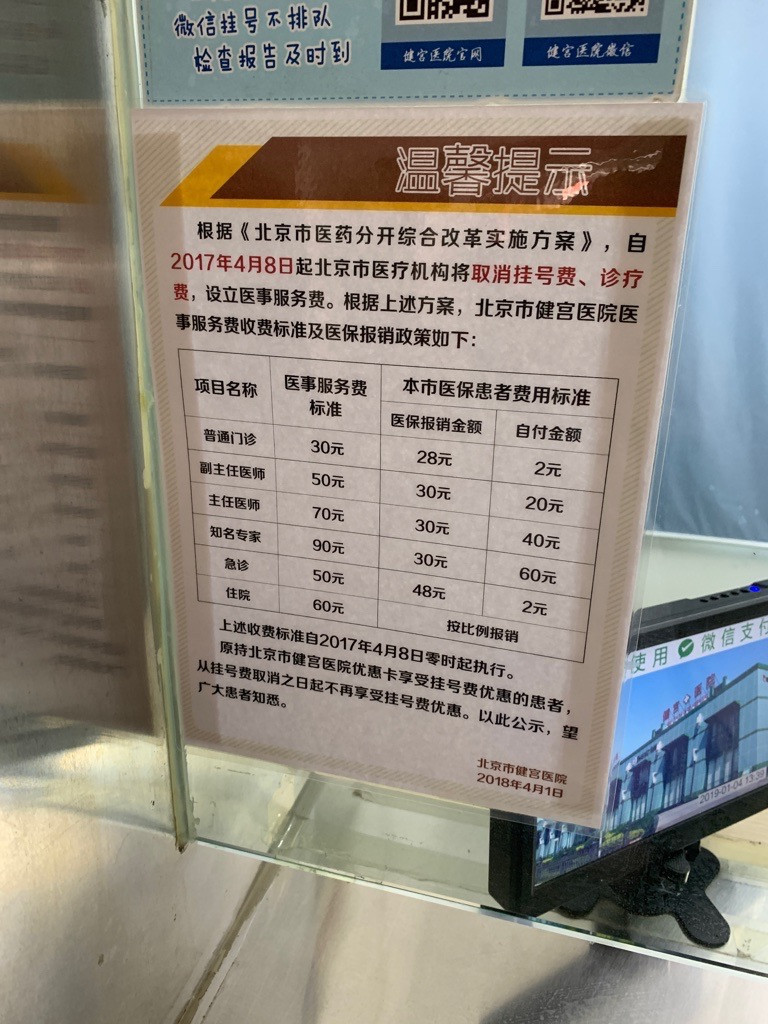
When buying medicines, up to 70% is covered (with its own subtleties), for treatment in a hospital – depending on costs. Here is an example of a calculation according to the proportion “paid by the social insurance fund\paid by the patient)”
Up to 10,000 RMB - 80%\20%
10,000 to 30,000 RMB - 85%\15%
30,000 to 40,000 - 90%\10%
Over 40,000 RMB - 95%\5%
Check the details on the website of your 社保局 and directly at the hospital. But in any case, as you can see, it is much more advantageous to be treated with insurance than without it.
What cards are there?
At the moment, what we find in use is first generation cards, which can be used only in places equipped with special terminals,
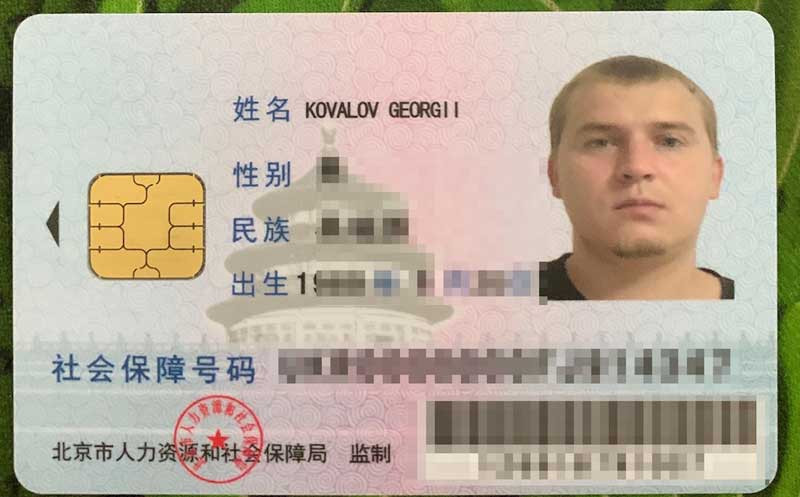
and second generation cards, which are integrated with the Unionpay payment system and are equipped with an NFC chip, on which you can write a preferential travel card, receive a pension, and so on. Naturally, this is unavailable to foreigners to a great extent.
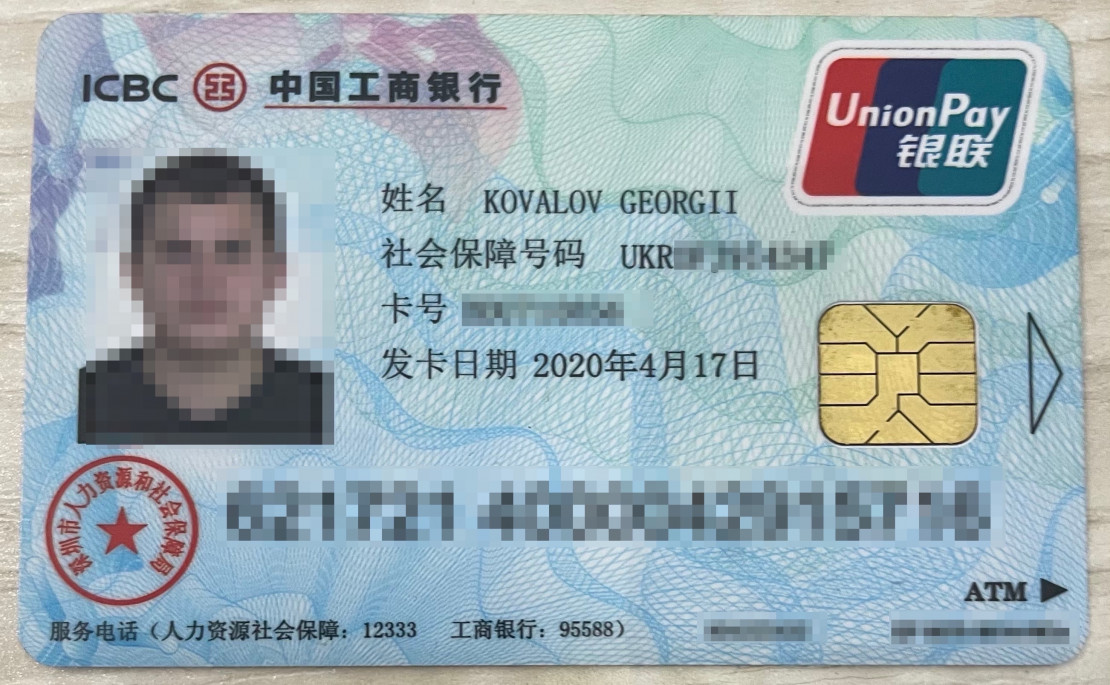
Second generation card combined with a Unionpay payment card
Can I transfer to another province?
Yes, when you change your place of residence, you can contact 社保局 at the place of original residence and transfer the accumulated amount to the fund of another province.
How to check?
As mentioned in the previous article, after getting a job, it is advisable to check that the employer pays the contributions correctly. You can ask the accountant to give you a printout, you can go to your personal account on the local 社保局 website (in fact, not, it is only available to the Chinese) or you can find any 社保所 on the map and print out the history of contribution payments in a terminal.
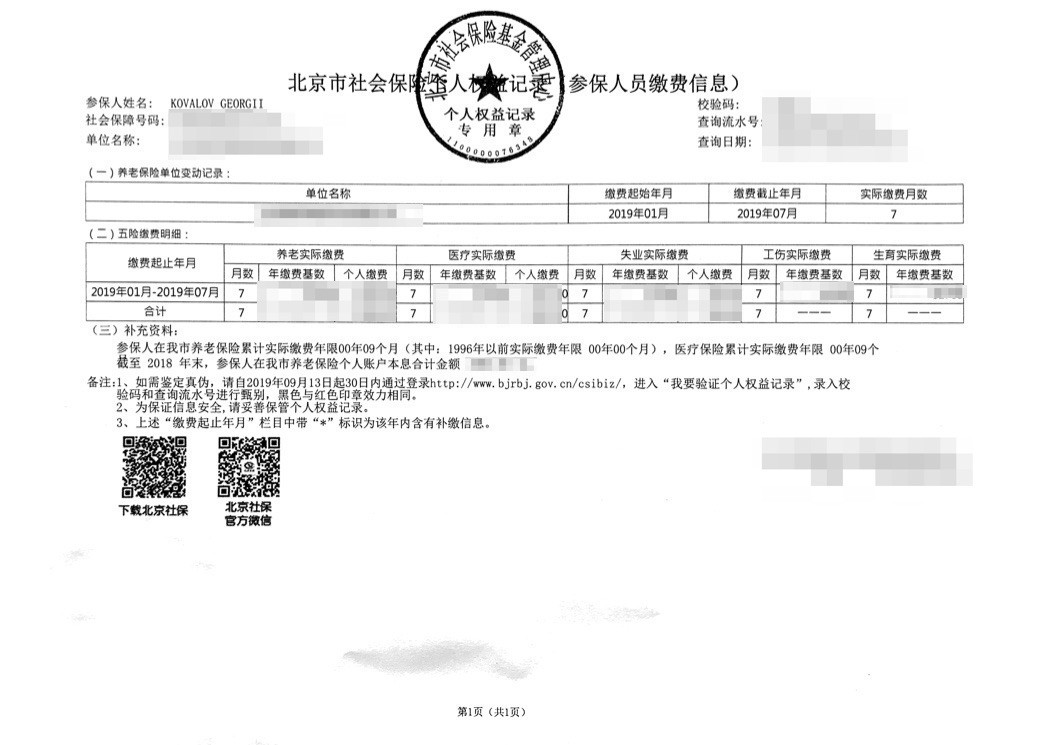
This is what a printout of detailed payment of social contributions looks like.
About job loss insurance. Loss means the end of the contract term, dismissal at the initiative of the employer, closure of the company – everything except dismissal at the initiative of the employee. Job loss insurance is paid to employees who have paid contributions in full. The amount of the payout does not depend on the number of employee’s contributions, but on the length of uninterrupted work experience in the last workplace and the regulations of the city social insurance administration (社保局 shèbǎojú). So, for Beijing in 2019, for example, a person who has worked continuously for 1 to 5 years will receive 1,536 yuan monthly for 12 months after being fired (or before getting a new job).
To obtain insurance, you must inform your district 社保局 shèbǎojú about job loss and register. And also possess Chinese 户口 (residency registration), which makes it impossible for a foreigner to obtain this insurance.
What about maternity allowance and work injury insurance? As a rule, foreigners in China do not engage in hard physical labor, where they can get injured. There is also hardly any information about cases of maternity allowance. If truth be told, a foreigner with social insurance in China can only use reduced-price healthcare and, in theory, receive a pension. For the same reason, if you leave China and terminate your employment contract, you can only take your health insurance and pension contributions with you.