Product / brand promotion in Wechat and Alipay
Nowadays, the clout of both Wechat and Alipay in China can hardly be overestimated. Not only do two companies – Tencent and Alibaba – control 91% of the online payment market in China, but they have also budded off a huge number of subsidiaries, related services, services within the same brand. Each of the companies provides its own set of services to promote your product or brand, often for free. Yes, almost all of their services are free of charge, with your only expense being the commission for payments made (from 0.1% to 0.6% depending on the field of activity).
The first thing to do is to define the terminology. Wechat or Alipay are only parts of the whole, so to speak – the top of the iceberg. A lot of services exist at the junctions – the goods are located in the Taobao store, payment is made through Alipay, while delivery is arranged through Cainiao. Or the product is in JD, consumers find out about it through a Wechat public account, pay via Wechat Pay, and delivery is done by JD Logistics. Despite the fact that each of the above is a separate service with its own registration, settings, API, admin panel and user interaction mechanism, everything, absolutely everything, is located within one and the same company – Alibaba or Tencent, perfectly interacting and being integrated with each other.
By the way, this spawns one of the biggest difficulties – it is often simply not clear whose technical support to contact and with whom to communicate. Moreover, as always happens in large companies, the old functionality sometimes duplicates the new one, some of the functionality is left to support legacy, admin panels of different directions are combined and disconnected, responsibility is transferred to other departments. Honestly, it’s a mystery to me how this heap works at all (and it works quite well, in fact).
Now then, Alipay is the payment system of the Alibaba holding. It includes both international wholesale and retail marketplaces (Alibaba and Aliexpress), domestic Chinese marketplaces (1688 and Taobao), 菜鸟logistics service (Cainiao), the actual payment system of Alipay, Aliyun cloud service, Alipay Global international gate, Eleme courier delivery and so on and so forth – the list is endless. Sometimes the services are built into each other (you can order food delivery through Eleme from the Alipay application, and return the goods by mail from Taobao through the Cainiao service built into the Taobao application). The same applies to Tencent. Therefore, we immediately agree that we are considering a simple case:
- a company is exclusively engaged in activities within China, working as a Chinese legal entity. The end consumers are individuals and legal entities residing in the territory of the PRC
- the company is engaged exclusively in the sale of real goods (neither games, nor financial services, nor online education, etc.)
- the activities of the company are not subject to special regulation (neither medicines, nor jewelry, nor antiquities, etc.)
Let’s omit the processes of transition of a product or manufactured object into a commodity – customs clearance, VAT from the factory, a business license, wages to employees – these are all separate topics. So, let’s assume that there is a commodity completely ready for sale and shipment. And get down to business:
Payments and related details
The first feature of both Alipay and Wechat that will help you is of course accepting payments. Directly, or through an acquirer – I elaborated on the nuances in the previous article. And it is this choice that will have a huge impact on all future activities of the company. Accepting payments directly, and not through an acquirer, has many shortcomings, the most significant of which perhaps is the need to continuously update the status of two systems instead of one. However, it also gives an enormous advantage – the possibility of further interaction with the user within the Wechat / Alipay ecosystem. Whereas in the case of an acquirer, you get only an impersonal transaction ID within the acquirer, and this is where the interaction with the consumer ends.
Naturally, there are solutions, but they all end up having to maintain two independent systems instead of one. Starbucks is a good case in point. Its coffee can be bought (at the checkout or through delivery) both with Wechat and Alipay – Starbucks has accounts in both of them, as well as public pages, mini-applications and the whole range of activities from discount coupons and loyalty cards to authorization through Open ID. When buying coffee from Starbucks in Wechat or Alipay, you interact with it directly as a Wechat or Alipay user. Things get more complicated if you buy coffee at the checkout through an acquirer (showing your Wechat or Alipay payment code). Here, the acquirer, depending on whose payment code is shown, may offer you to provide your ID. Should you not provide it, you will remain an impersonal buyer, about which Starbucks only knows the ID in the acquirer’s system. Should you agree, you will link your given transaction and ID to your Wechat / Alipay, which will make it possible to involve you in more and more new Starbucks services within these two ecosystems. If the merchant uses an acquirer, but only supports Wechat, for example, then the consumer will still be able to pay with Alipay, but it will not be possible to involve this consumer, since there will be no one to transfer their Alipay ID.
Here is an example of how it is implemented in Alipay when paying at the checkout through third-party acquirers. When paying with Alipay through a third-party acquirer, Alipay may send a link to your discount card or miniapp to the client.
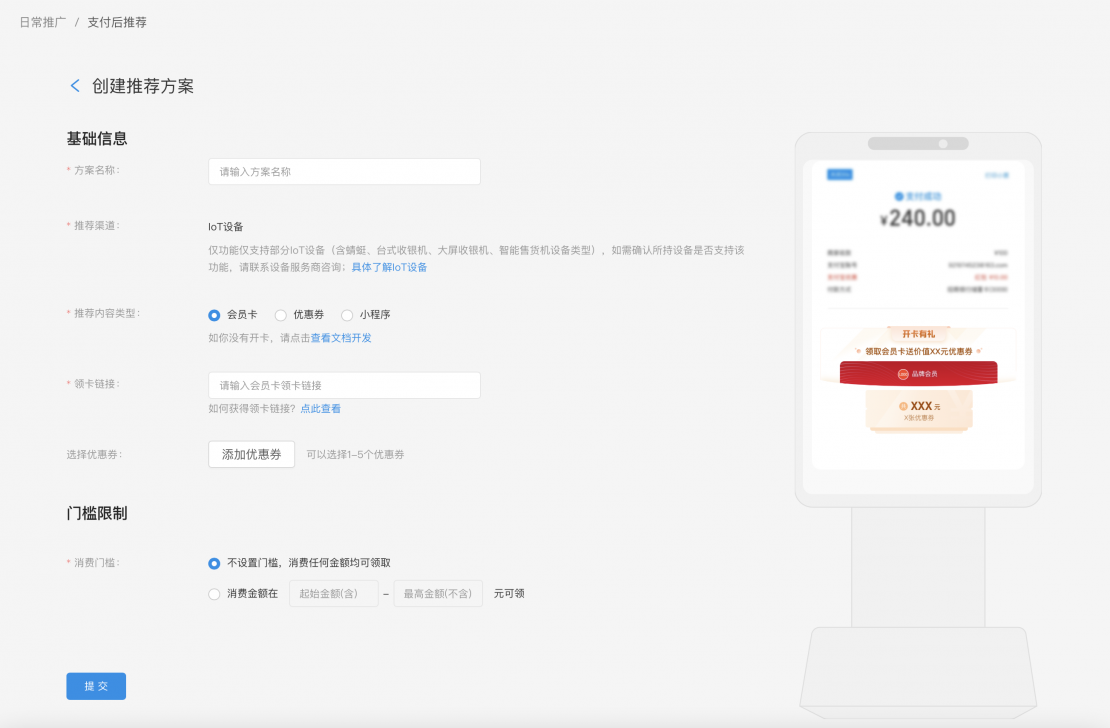
Pretty confusing, but in general, what a merchant needs to know is that if you want to be successful, it is highly advisable to develop your services with both Wechat and Alipay.
So, let’s get down to it. I will consider the common points of Alipay and Wechat together, since they are often identical.
Promotion
By accepting payments through Alipay, you gain access to the entire Alibaba ecosystem. Obviously, you should start with the merchant’s payment account, i.e. the Alipay website proper. Please, do bear in mind that everything is intentionally separated and different admin panels and accounts are created for different tasks. A merchant’s payment account is the thing that can accept money. No more, no less. When registering on the developer portal open.alipay.com, or on the promotion portal grow.alipay.com, you will each time have to provide additional information about yourself as a developer, for example, whereas the merchant’s payment account is needed only in order, for example, to add the ability to accept payments to the application being developed. To put it another way, it does not look like “one single account where we connect the payment acceptance function”, it is “a developer account where we create an application and to which we connect a merchant’s account in order to accept payments”. This features a certain division of roles, since payments can flow into one merchant’s account from dozens of different sources, and a specific source does not at all need to have access to the overall financial information. All of the above applies equally to Wechat, even the domains are often the same: open.weixin.qq.com is a developer platform, mp.weixin.qq.com is a promotion platform and so on.
But since the topic of the article is promotion, the main object of consideration will still be the admin panel of grow.alipay.com (recently merged with business.alipay.com ) and mp.weixin.qq.com, where all the management of advertising and promotion takes place directly. In general, you can see all the statistics in it (with the exception of financial), but we are only interested in promotion.
The first, and virtually the foremost, thing is a public account. Alipay calls it 生活号, while Wechat calls it 公众号. This is, in fact, a news feed with useful links.
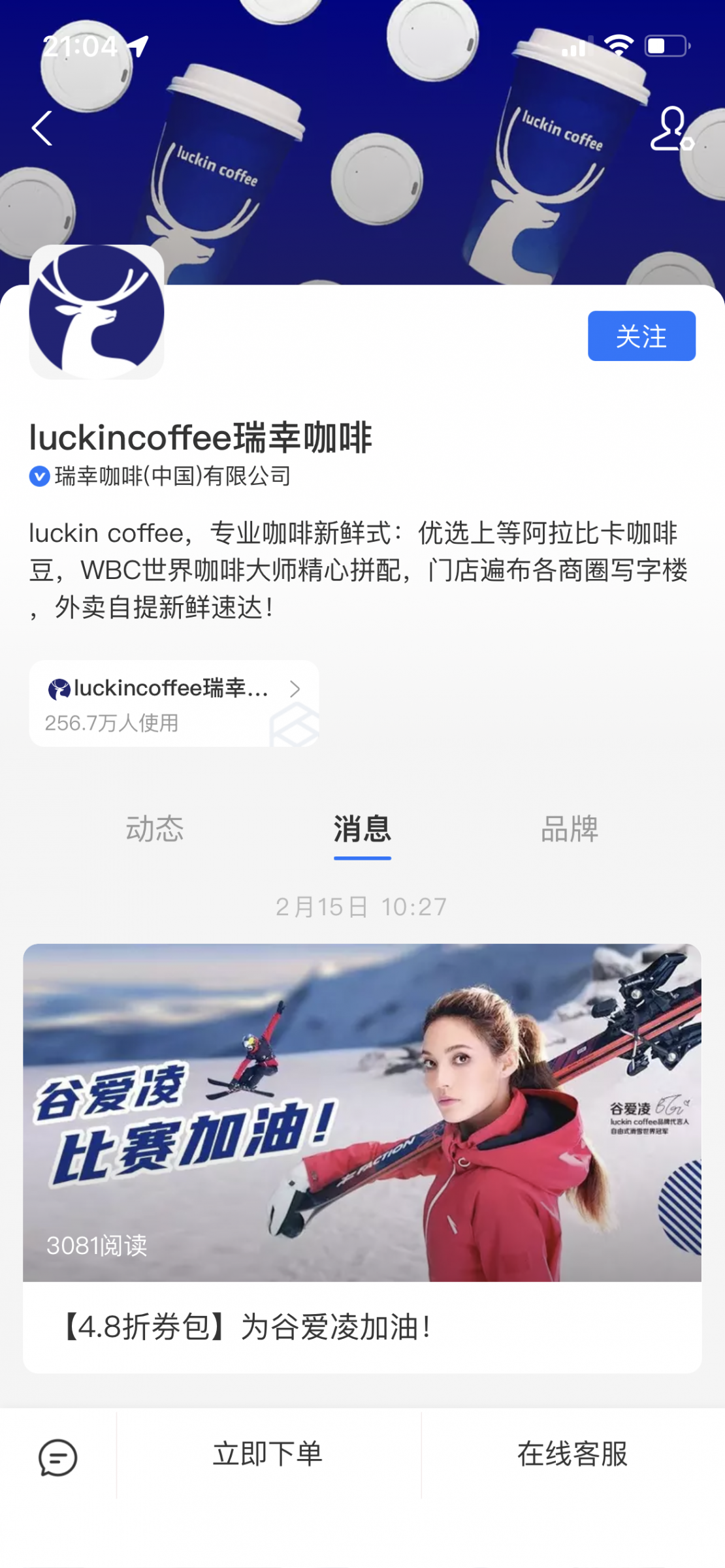
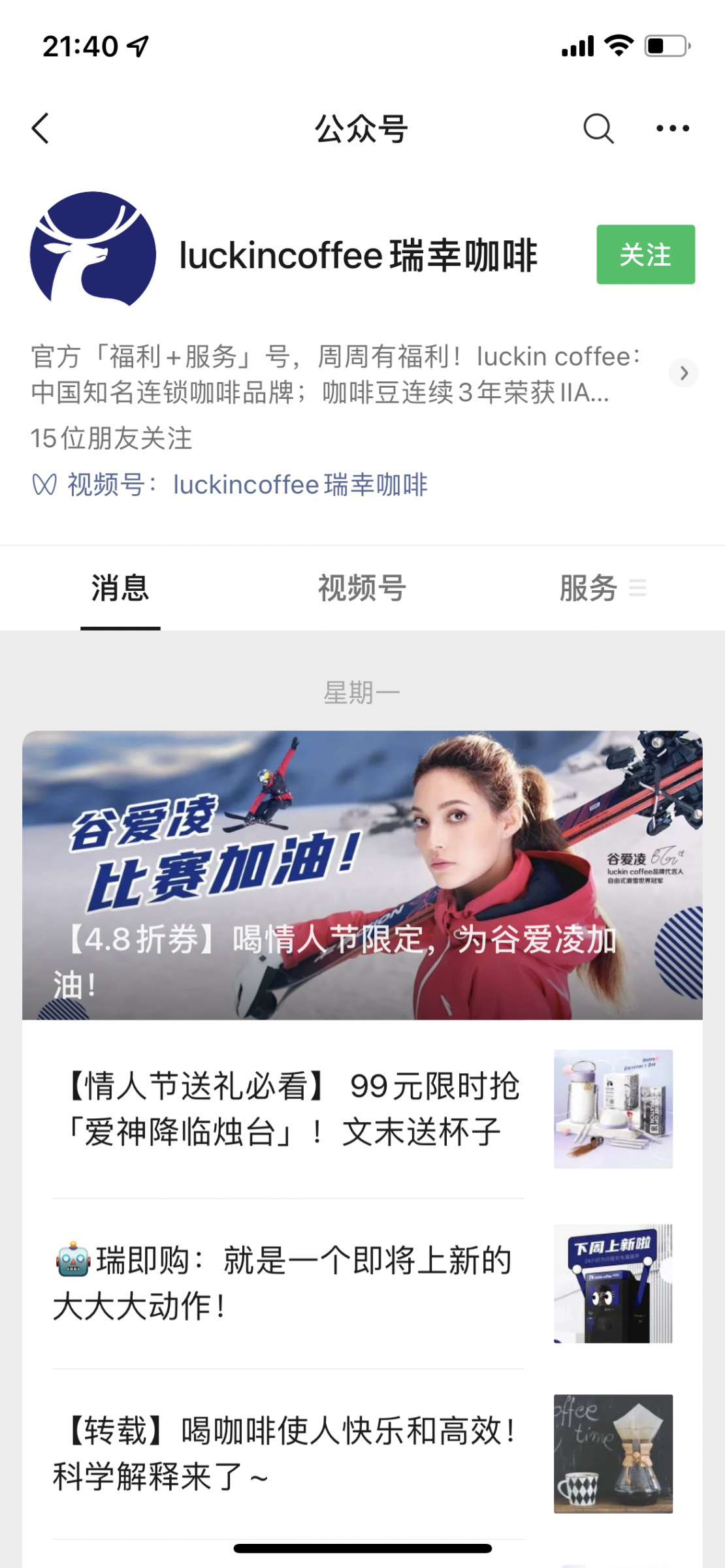
Alipay on the left, Wechat on the right
For example, this is what the public page of Luckin Coffee looks like. Picture and brand logo, description, published news (for example, about new promotions), buttons for interaction (in this case, for ordering coffee to go). The method of working with it is also pretty clear – the more people subscribe to you, the greater is the number of users to whom you can convey information about new promotions, arrival of a new batch of goods, etc.
What is there to bear in mind when dealing with a public page?
- there should be continuous publication of new content. It will be better if the materials are of interest to subscribers, but the main thing is that they appear regularly, with the maximum possible frequency. Alipay allows to publish news (depending on the type of news, account type and target audience) either 4 times a day or 3 times a week. In Wechat – either 1 time per day or 1 time per week.
- there must be retention elements in the public page. News is good, but the customer should be able to receive all services in one place. Checking the status of an order, seeing their VIP level, learning about new discounts and finding a store nearby, contacting technical support, and sharing a discount with a friend.
- The number of subscribers keeps dropping. The inflow of new ones should outstrip the outflow of old ones. The retention rate for different types of accounts varies, but on average we can assume that you lose 2% of subscribers every week. Correspondingly, there should be more than 2% of newcomers
- the public page needs to be promoted. By itself, it will not be able to gain subscribers, regardless of its beauty, functionality and design.
In my personal opinion, in this aspect, Wechat wins a stunning victory. At least due to the possibility of creating sub-news and a much more convenient news editor. For example, in Alipay, the editor does not support creating tables. It lacks convenient text markup for headings, quoted text, etc. And most importantly, it is very poorly integrated with other Alipay services.
For example, in the Wechat editor, a word can be made a clickable link either to an external web page, or to a Wechat mini-app, or to a Wechat video account, or even to geolocation. This is not possible with Alipay. You do the maths
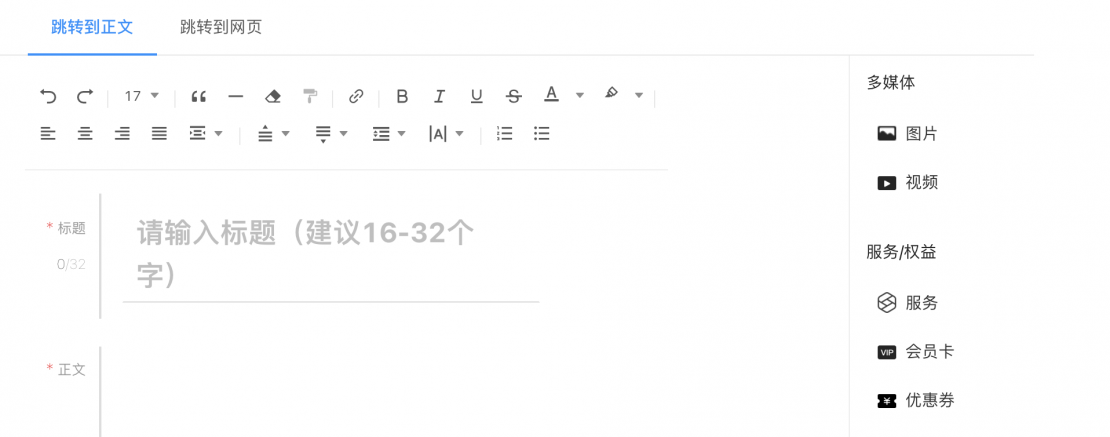
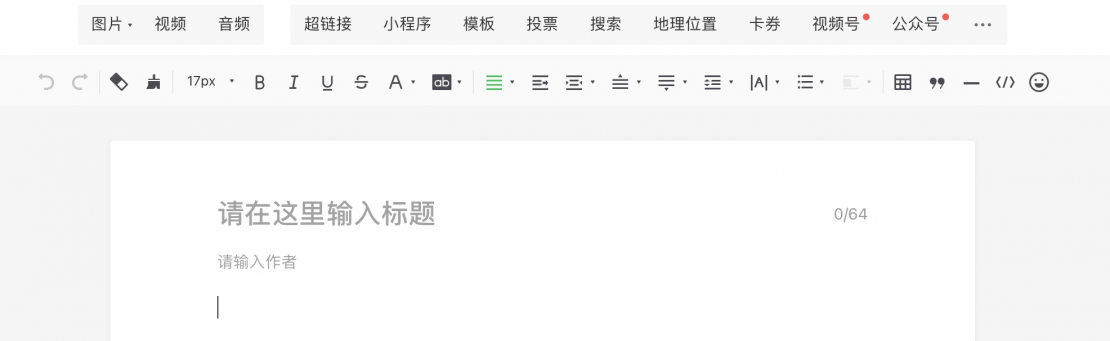
Alipay news editor at the top, Wechat at the bottom. The difference is clearly visible even in the screenshots
The rest is quite simple. Publish news, check the number of views of each one. Increase the number of likes and reduce those that have not caught an eye, and so on. And constantly develop it, by adding and adding functions.
But a public account is not even a promotion, it is rather a must-have element, it is a landing page, without which everything else is simply meaningless. Now directly to how we will promote it.
As you know, both Alipay and Wechat have a search bar. And this is it that is the crux of the matter. As you also know, web search is losing ground every day (I recommend the excellent article “Why Google Search is Dying”). In short, web search is moving from directly searching on relevant sources to searching on the most SEO-optimized websites with no guarantee that the search object will be directly found on a website. In China, web search has never been popular. Whereas Wechat and Alipay at least try to guarantee relative relevance of search results.
Try searching for “coffee” in Google, and then in Wechat and Alipay. In the first two, one third of search results will be crammed by articles “Coffee from A to Z” and “The benefits of drinking coffee have been proven”. One third will be about wholesale coffee deliveries, marketplace advertising, and others, and only the remaining third will be links to coffee delivery. In Wechat and Alipay, absolutely all the results are nearby coffeeshops and delivery of ready-made coffee to your home. In any case, this is a very debatable issue and now we will not dwell upon it. By contrast, let us move on to discuss how to squeeze into the search results of Wechat and Alipay search bar.
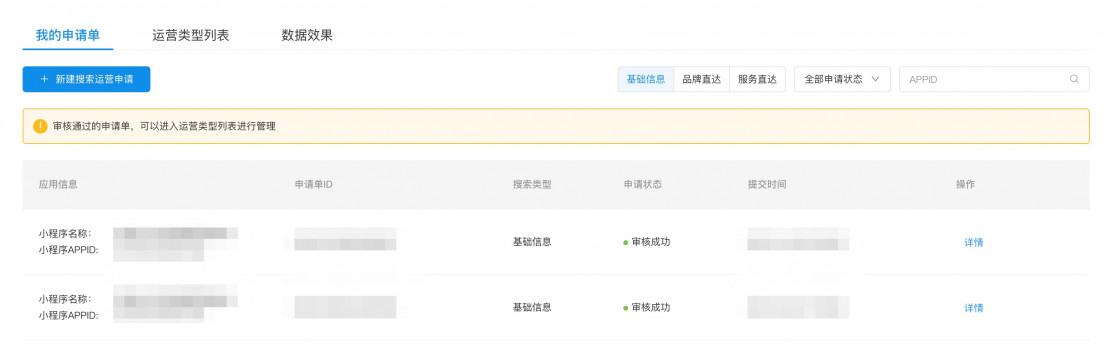
There are three ways to get into Alipay search. All of them are in the 搜素运营(search and promotion) section:
- 基础信息 (basic search)
- 品牌直达 (brand page)
- 服务直达 (direct service)
The easiest way is with 基础信息. These are, in fact, regular keywords, just like in a search engine. Depending on the rating of your application, which was given by Alipay and the corresponding level (C, B, A) and a rating from 1 to 10, you can select the number of keywords – from 5 to 15. The user enters them in the input line and sees your public account. Well, or does not see if the keywords are all too popular.
You can’t pay for raising, such a function is simply not provided. It all depends on the SCI – the level of competition, which is calculated automatically.
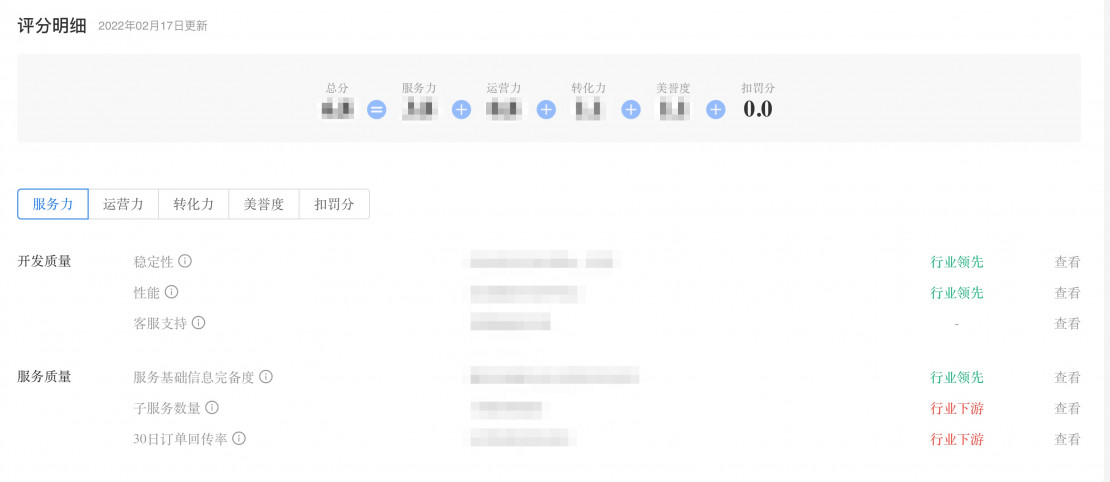
It consists of 5 items:
- 服务力 – service level (stability, functionality, technical support)
- 运营力 – number of users, number of orders, amount of transactions
- 转化力 – conversion of new customers and retention of old ones
- 美誉度 – user attitude, ratio of positive and negative reviews, percentage of returns
- 扣罚分 – penalties and fines. They are not added, but subtracted.
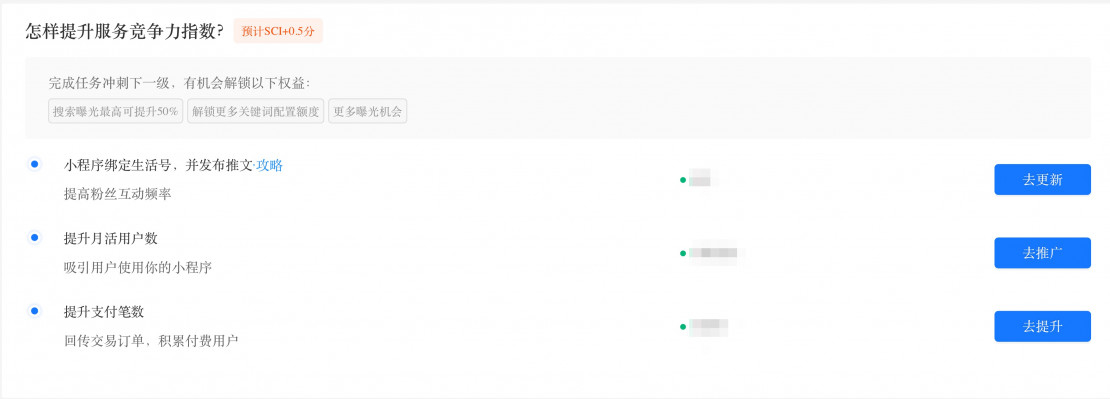
“Quests” are always launched to raise the SCI index. So, we are encouraged to publish more 推文on our public page, increase the number of active users and boost the number of transactions. For this, they promise to add 0.5 points of the
SCI index, unlock more keywords, increase the chance of random display in the first place of search results
Anyway, you won’t be able to make a full-fledged use of the Alipay ecosystem without an application. The public page is good, but the app is better. Accordingly, you need to create an application (a mini-app in Alipay or Wechat), or a native application for iOS / Android , where you can integrate everything. By creating an application and connecting everything you need, it becomes possible to use the following tool – 服务直达. It’s a kind of “direct service”.
It is very similar to keywords, but with one important distinction – as a result of the search, a direct transition to the service provided is immediately available, bypassing landing pages. Accordingly, the requirements are also stricter – it can be seen that our keywords were approved right away, whereas we had to change a lot of things with the services before getting approval.
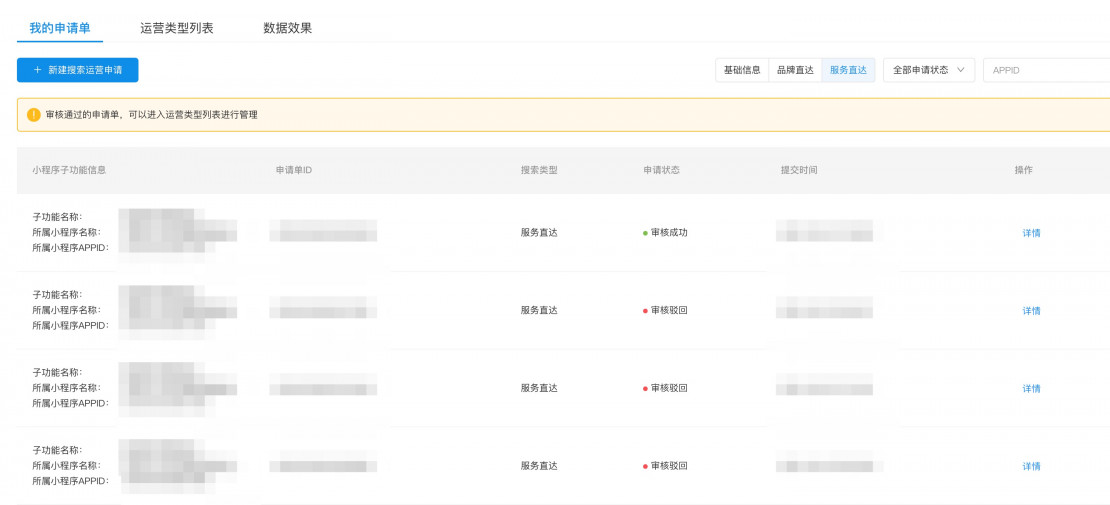
Accordingly, in case of an ordinary addition of keywords, only the relevance of the content is checked. While in case of providing services – the actual provision of them. That is, whether the applicant can provide the services that it seeks to promote, whether it has the resources for this, etc. Upon approval, when there is a search for “coffee”, your public page / application is no longer just hanging out somewhere in the general list – they are singled out and are supplemented with an “order coffee” button, which is a direct link to the application.
Finally, what the whole thing was driving at – 品牌直达. This is a sort of “brand corner”. A qualitatively new stage, when the user enters almost any combination of characters which includes the name of your brand – and the search bar is painted in your colours, a much larger selection of related functions is available, you can place your own banners and a great deal more. The main condition is the ownership of a TM + many additional conditions.
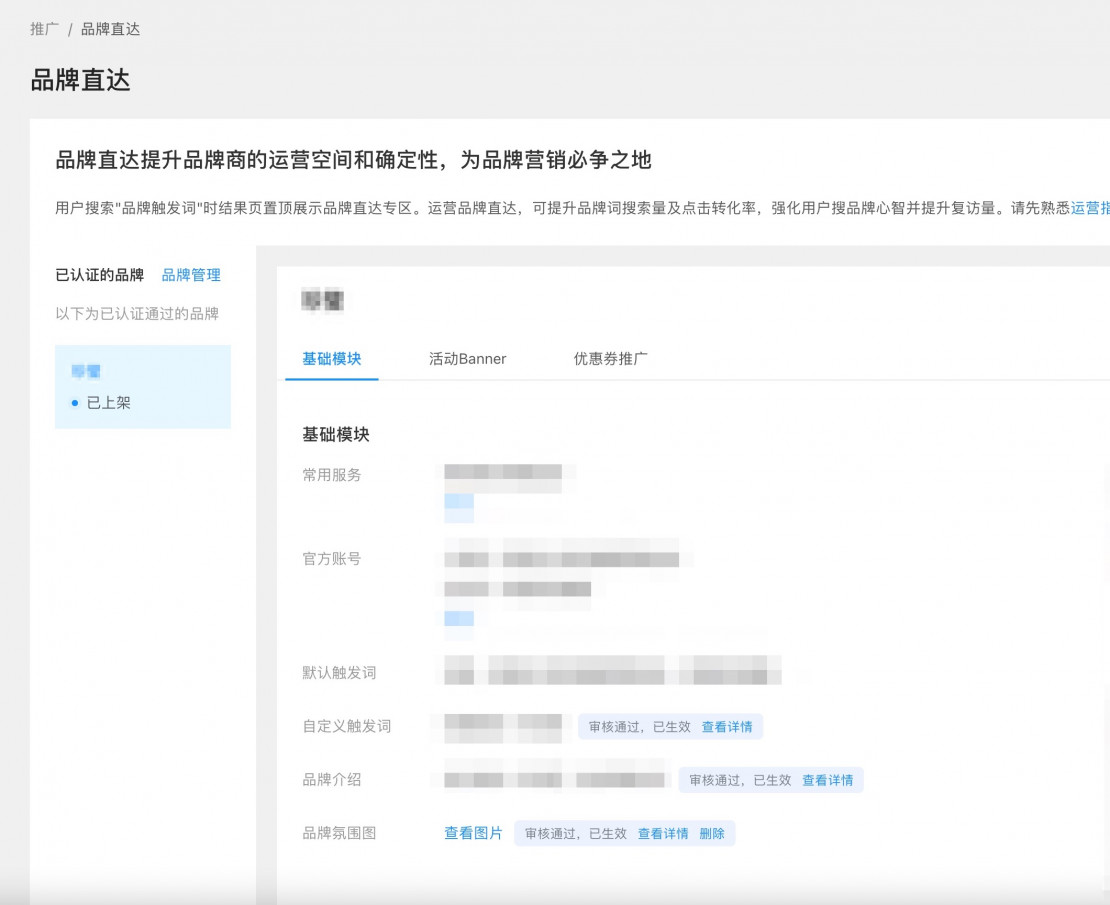
One of the few SCI parameters that are openly available to everyone is the number of users. When searching for anything, you can see the approximate number of users for a brand (surely, only approximately)
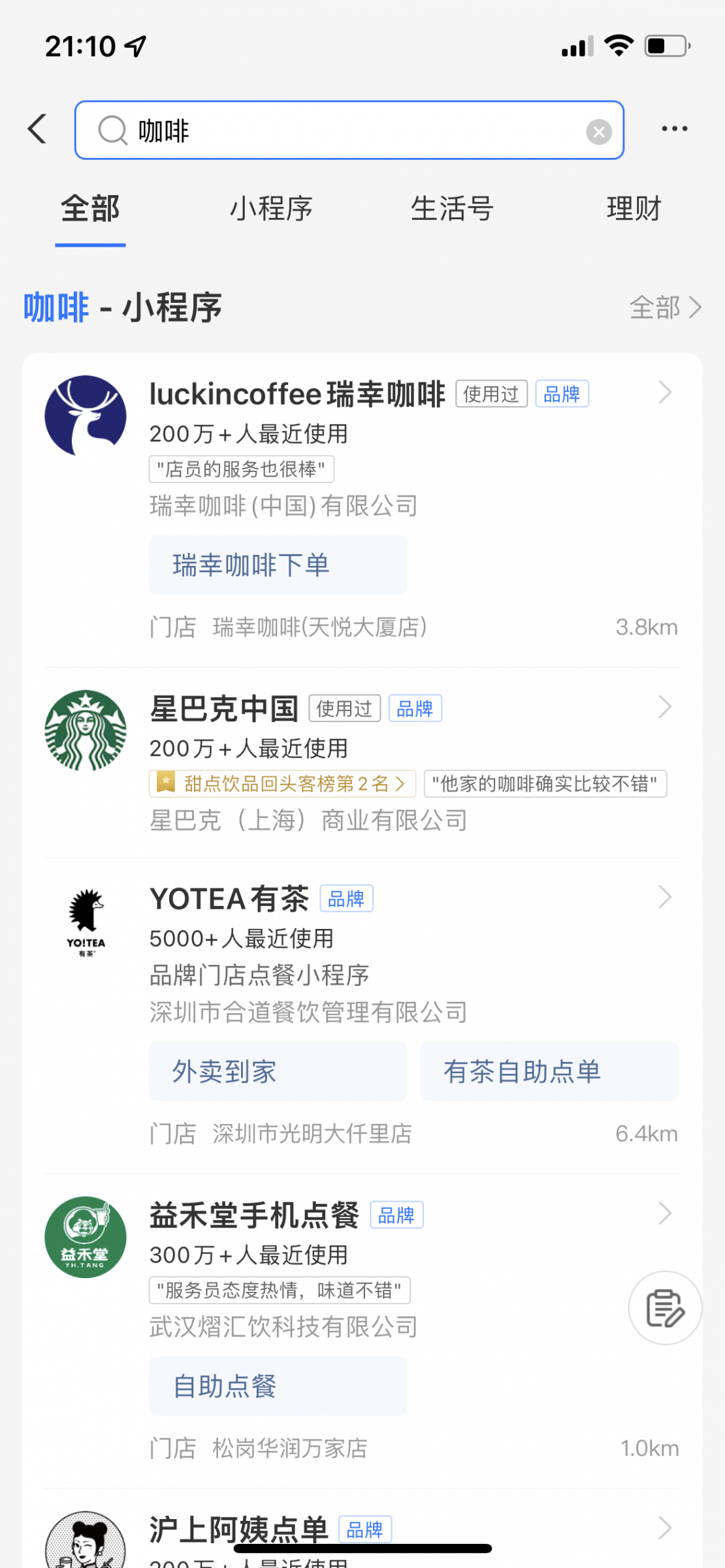
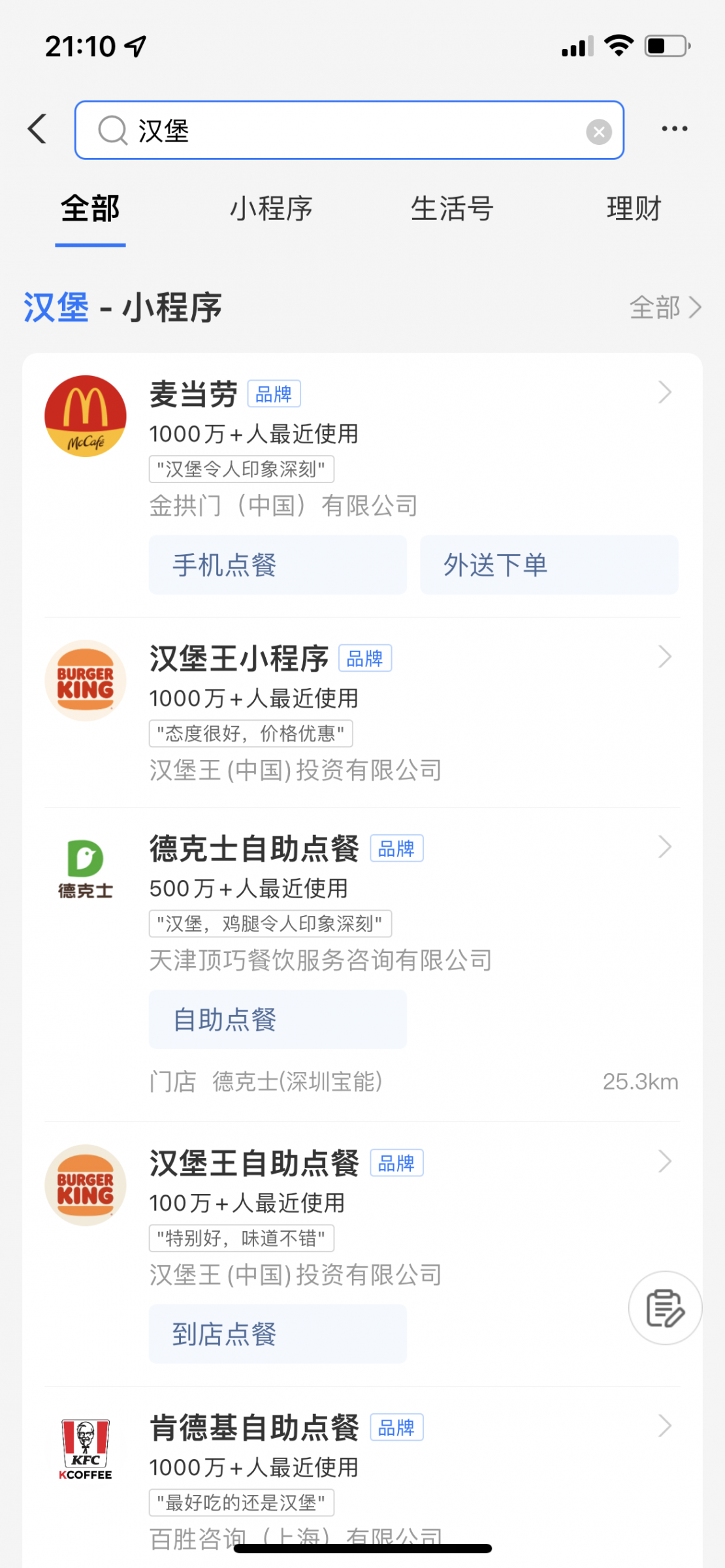
In the case of the query “hamburger”, everything is obvious – all the top ranks are occupied by fast food chains. But with the query “coffee” things are not as straightforward – why the all-Chinese益禾堂, which pervades literally every yard, is lower in the search results than Shenzhen’s local 有茶 – this already gives food for thought. However, as you remember, SCI is calculated not only on the basis of the number of users. Anyway, each specific case must be analyzed and dealt with separately. Actually, for such competitive requests, everything is extremely difficult to analyze.
Now let’s turn to Wechat. A lot of things are pretty similar. Exactly the same sort of search results, exactly the same competitiveness index, based on the number and amount of transactions, as well as the number of active subscribers. The same public pages and mini-apps. One of the most important differences is that Wechat has paid advertising, unlike Alipay (we are not talking about banners on Taobao and other Alibaba resources). To be more precise, this is not advertising in Wechat, but in the general advertising network of Tencent – e.qq.com, which has Wechat “Moments” as one of its elements.
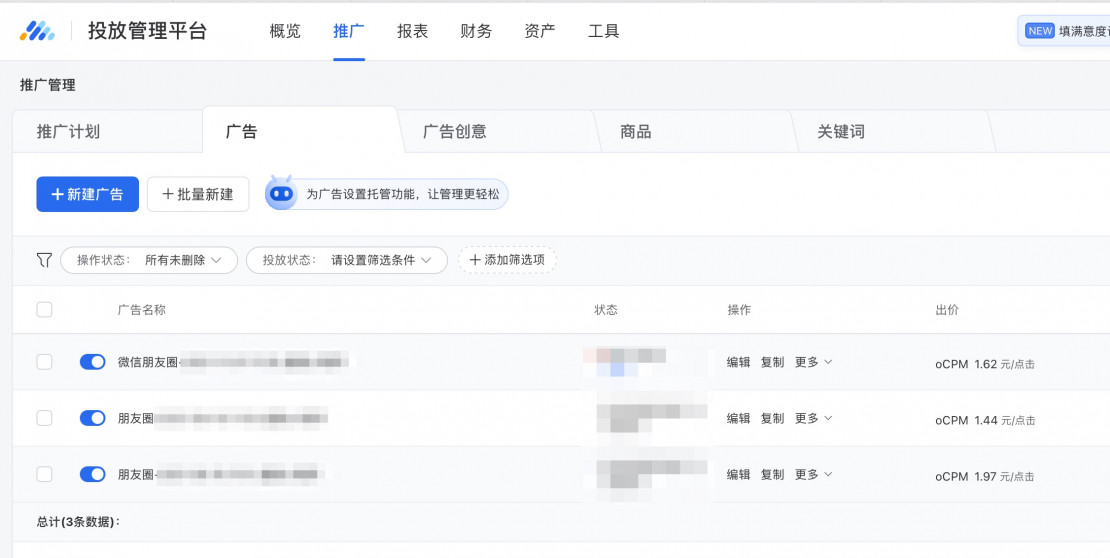
But even there it is quite modest and the maximum that the user will see is an advertising post in the general feed of 朋友圈. Paying for advertising does not affect search results in any way. In general, advertising here is not too different from the usual advertisements – advertising banners in the general feed, advertising inserts before playing a video, etc.
Generally speaking, everything is similar, with the exception of minor points, which of course are quite numerous. But all these boil down to different variable names and different default post widths in pixels. Significant variations occur only when it comes to financial statements and the withdrawal of money, but this is already far beyond the scope of the article.
The article failed to mention discount coupons and loyalty cards. It was not possible to bring up live streams and video accounts. As well as adding a merchant to the map, setting up auto-replies in public pages, creating bots and end-to-end technical support. Integration with delivery and return services. Otherwise, it would not be an article, but a book.